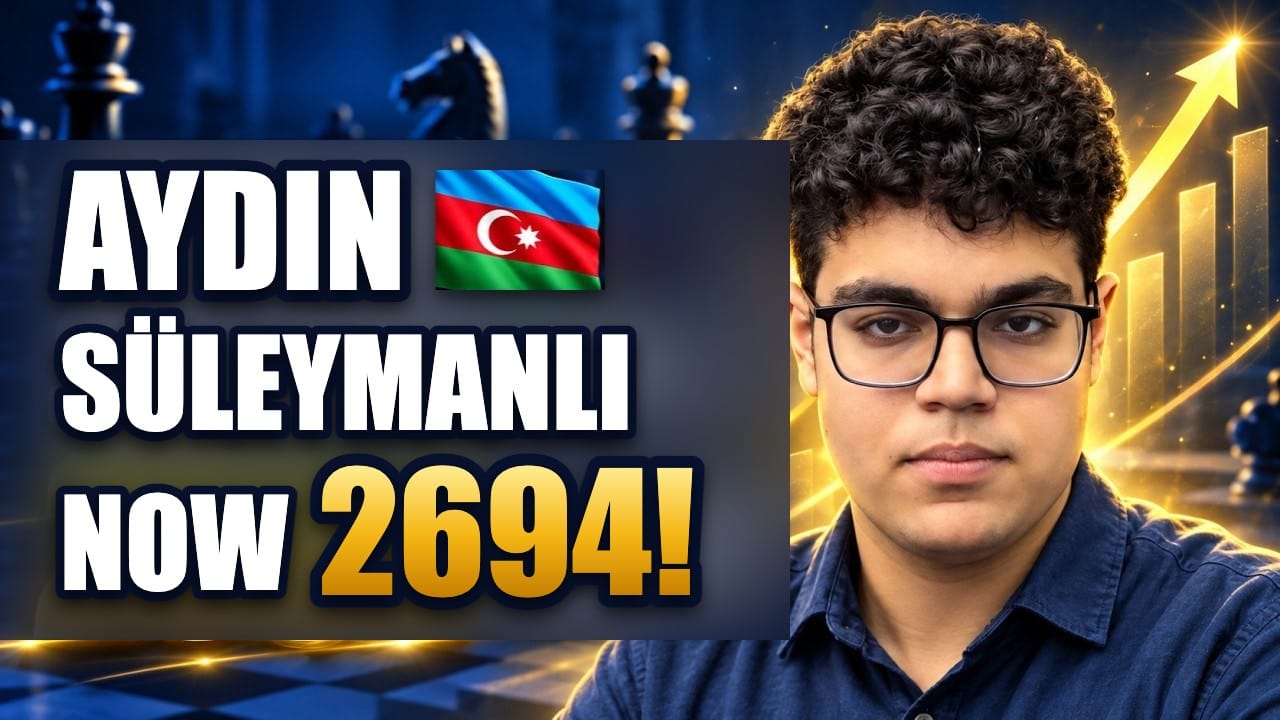
Round 4 of the European Chess Club Cup produced a derby of the Turkic chess world: on one side Aydın Süleymanlı (2679), Azerbaijan's rising star climbing fast towards 2700; on the other Nodirbek Abdusattorov (2780), world number 4 and, together with Sindarov, Uzbekistan's brightest name. Playing White, Süleymanlı chose counter-attack over moving an attacked piece to safety, and beat one of the best players in the world.
Below you can play through the whole game with the commentary from the video, and then try to solve the critical positions yourself.
Annotated Game
Click on the moves, use the buttons under the board or the arrow keys on your keyboard to step through the game. The board is shown from the side of Aydın, who has the white pieces.
Critical Positions
Four positions highlighted in the video. White is to play in each one. Think for yourself first, then open the answer or use the forward button under the board to see the move played.
Critical Position 1 – move 15, White to play
Show answer
15.Qc2!! Black has just played a6, “I am kicking the knight”, and almost everyone would retreat it. Instead Süleymanlı goes for a counter-attack. If Black takes, 16.Bxh7+ Kh8 and now comes a backward move: 17.Ne1! (17.Nd2 fails to Nf4, blocking the knight's route and the bishop's diagonal). The idea is Rh3; after 17… g6 18.Bxg6 fxg6 19.Qxg6 there is no defence against mate. Making a threat and moving an attacked piece away is the basis of chess; the next level is seeing the counter-attack.
Critical Position 2 – move 26, White to play
Show answer
26.h3! Not merely luft. Playing 26.Qh6 at once runs into 26… Qg4!, and after 27.Ng5 Black holds the mate with 27… Qh5. h3 removes Black's only defence before it exists, and it also prepares a flight square for the king. A prophylactic move with two jobs.
Critical Position 3 – move 30, White to play
Show answer
30.Qh6! The evaluation bar jumped to +3. From here Black's only chance was 30… Qf1+ 31.Kh2 Qxf2 – and Abdusattorov missed it. Even in that line White wins with a deflection: 32.Rc2! After Qxc2 comes 33.Ng5 and there is no defence against mate, because the black queen can no longer reach f4.
Critical Position 4 – move 36, White to play
Show answer
36.Qxh7+! The engine's first choice; White gives up the queen. After 36… Kxh7 37.Ng5+ Kh6 38.Nxf3 White enters a clean endgame two pawns up. Süleymanlı spent a good part of his remaining 13 minutes here; there were two good continuations and he picked the safe one.
Lessons from the Game
- Move order changes more than the name of the line: Because White played 3.Nf3, Black chose d5 rather than b6, and 4.Nc3 dxc4 entered the Vienna Variation. The follow-up 5… b5 is only possible in this exact order: the pawn is protected, because 6.Nxb5 runs into 6… Nxe4.
- Moving the attacked piece is not the only option: 14… a6 was met by 15.Qc2!! The average player thinks “he threatened me, so I run or I defend”. Moving up a level means adding techniques like counter-attack and deflection to your repertoire.
- A strong square is not enough on its own – it needs a target: 13… Nd5 puts the knight on a fine square, using the d4 pawn as a parapet. But at that moment it only controls; it is not firing at anything. Once a target appears – or once the queen goes in front with the bishop behind, aiming at the king – the square becomes far more valuable.
- A good backward move deserves an exclamation mark: In the line 15… axb5 16.Bxh7+ Kh8 the winning move is 17.Ne1. Going forward is the rule in chess, which is why backward moves are both hard to find and usually bad; the exceptions are the moves that make you a strong player.
- Prophylaxis erases the defence before it appears: 26.h3! wiped out the Qh6 – Qg4 – Qh5 defence before it could be played. Closing your opponent's single escape route before you attack makes the attack twice as strong.
- Deflection targets the piece that holds the mate: In the line 30… Qf1+ 31.Kh2 Qxf2, White plays 32.Rc2! The point is not to save the rook but to pull the defender of f4 away from its post. Once the queen takes on c2, Ng5 closes the mating net.
- Even a winning position needs fine tuning: After 32.Rc7 the evaluation was +4.3, but automatic moves are not allowed: instead of 39.Kg2?! there was 39.Rf7! (39… g5 40.Rf6+ Kh5 41.g4#). Small slips like this in time trouble pulled the evaluation down to +0.8.
- Do not be seduced by a check: 42… Bc6+? did nothing except help White: his king was going upstairs anyway. The engine's move was 42… Bc4 – hold the pawn and run with it. As the late Ali Bey used to say: “A Turkish player never passes up a check.”
Notes and Anecdotes from the Video
- Former student against current student. Süleymanlı's coach is former world champion Rustam Kasimdzhanov. Kasimdzhanov once coached Abdusattorov as well and captained the title-winning Uzbek team; he no longer works with Abdusattorov, he works with Süleymanlı. So the two sides of the board held the same coach's former and current student. “An incredibly warm person.”
- A second 2700 for the Turkic chess world. Süleymanlı is one of the players supported under the Chess Talents project, whose goal is plain: produce another 2700+ player from the Turkic world. At the time the video was recorded his published rating was 2679 while his live rating had risen to 2691 – around 70 Elo in a single year.
- The Chaturanga analogy. Chess began as a war game; its first name was Chaturanga, “four armies”: pawns, knight, rook, bishop. The knight on d5 is waiting behind a parapet – the d4 pawn – to shell the enemy camp: “but right now it only controls, it is not firing at anything.”
- The information came from Shakhriyar. The 30… Qf1+ idea that Abdusattorov missed was passed on after the game by Shakhriyar Mamedyarov. Black had been thinking “I wriggle out like this and it is a draw”.
- Body language is an analytical tool too. “If Süleymanlı brought the queen there with that much confidence, something is up,” you say to yourself. The moment an opponent gets excited and goes under is visible at the table rather than on the board. And on seeing 32.Rc2!, “boiling water is poured over the grandmaster's head.”
- Counter-attack is a technique you can learn. The video points out that this theme is covered in detail, with fine examples, in the Chess Mastery Course; the same chapter is in the videos given to everyone who played the last tournament: “things that come free sometimes feel worthless, but please listen to that part.”
Video Commentary
Source: the video commentary on the Satranç Okulu YouTube channel (in Turkish) and the Lichess study.