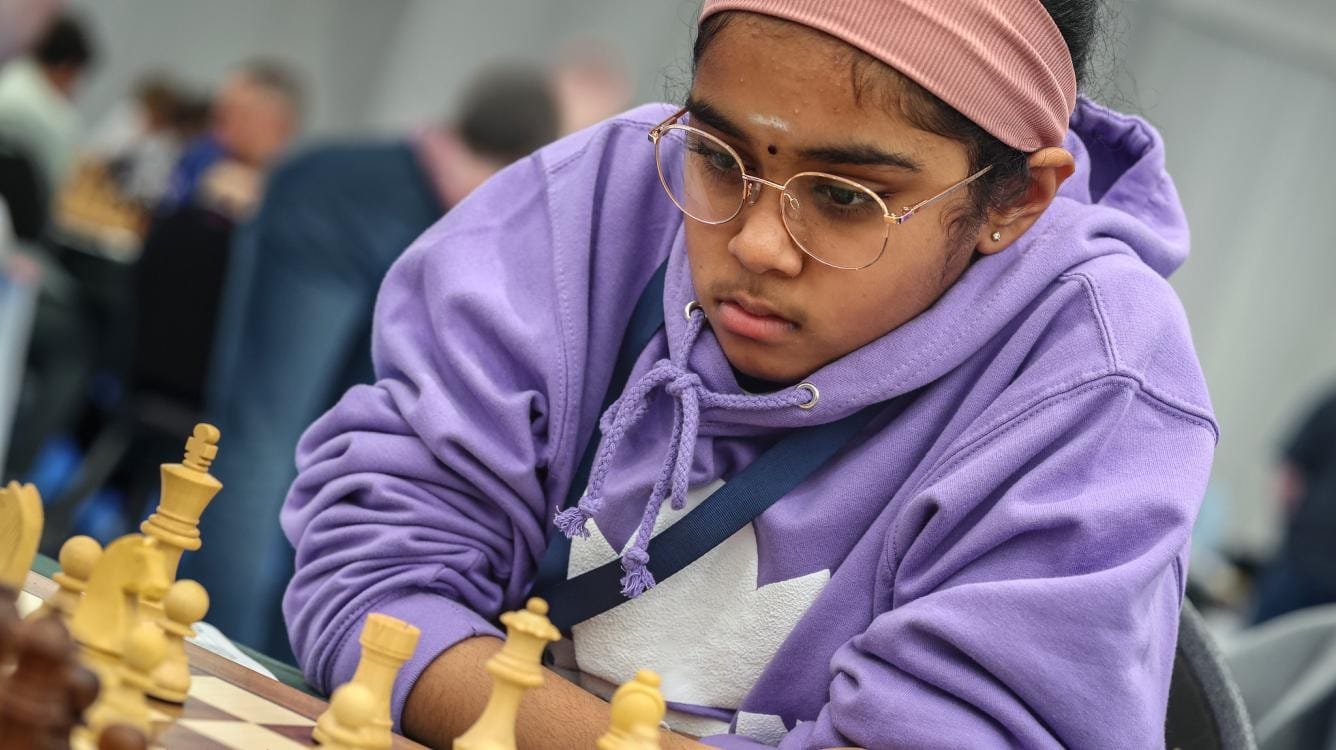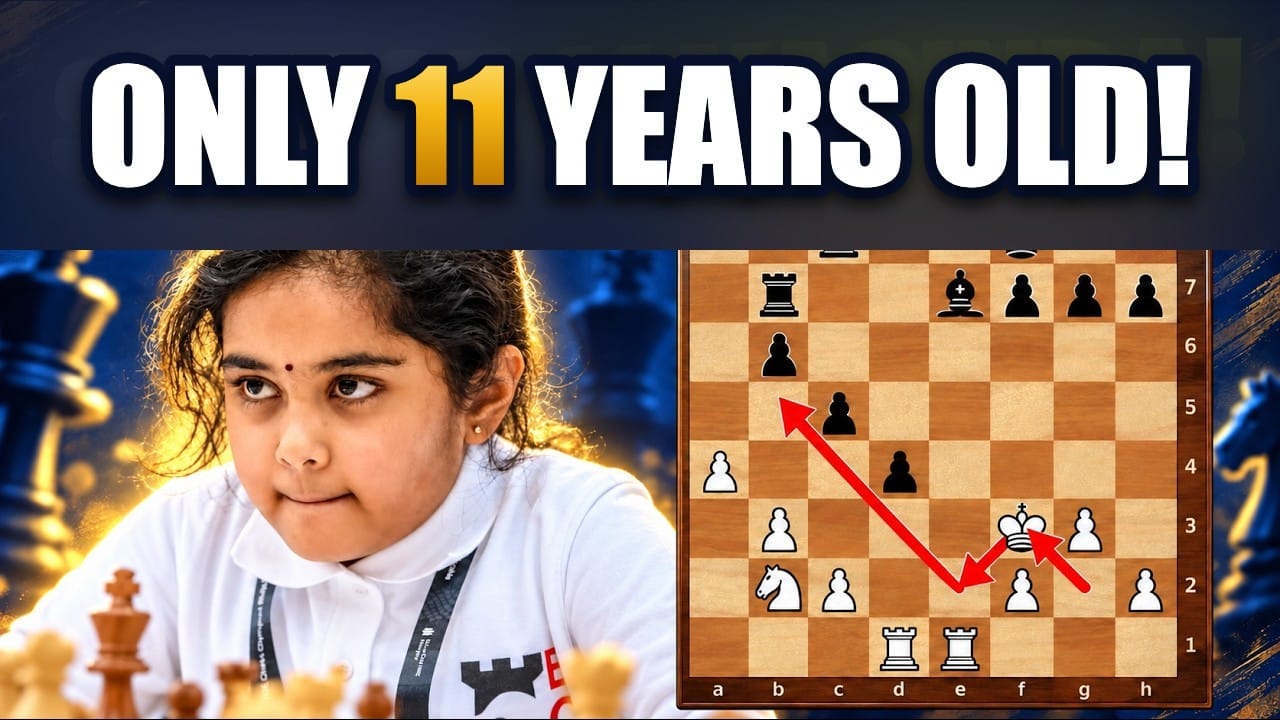
While the European Chess Club Cup goes on, a star is shining in the women's event too: Bodhana Sivanandan (2382), still only 11 years old, has scored 4.5/6 and is playing at a 2461 performance. Supported under the Chess Talents project, Bodhana gets training from our dear friend Mert Erdoğdu. In round 2 of the women's event she beat WFM Sri Darshini (2191) with the white pieces in 73 moves.
We like to compare Bodhana's style to Capablanca, and this game is a model example of it: turning an isolated pawn into hanging pawns, targeting the dark-square weaknesses, the Bc1 – Nb2 – Nc4 manoeuvre, good knight against bad bishop, and an active king in the endgame. Below you can play through the whole game with the commentary from the video, and then try to solve the critical positions yourself.
Annotated Game
Click on the moves, use the buttons under the board or the arrow keys on your keyboard to step through the game. The board is shown from the side of Bodhana, who has the white pieces.
Critical Positions
Four positions highlighted in the video. White is to play in each one. Think for yourself first, then open the answer or use the forward button under the board to see the move played.
Critical Position 1 – move 24, White to play
Show answer
24.Bc1! Think of a manoeuvre: how can we bring our pieces to better squares? The bishop has done its job on b2; more importantly, by stepping back it clears the way for the Nb2 – Nc4 manoeuvre. c4 is a strong square for the white knight and c5 is a backward pawn. Black did not pay much attention to the idea, or underestimated it: 24… Qb7 25.Nb2! and the knight settles on c4. The engine suggests 24… c4 for Black, but after 25.Nb4 Bxb4 26.axb4 the d4 pawn is a target again and Bf4 is threatened.
Critical Position 2 – move 29, White to play
Show answer
29.Bxb6! You need a good reason to give up a bishop for a knight – and here there is one. After 29… axb6 comes 30.a4, and the knight settles safely on c4: good knight against bad bishop. Black's bishop is on the same colour as its fixed pawns on c5 and d4 – a structure that recalls Capablanca's endgame against Rubinstein.
Critical Position 3 – move 41, White to play
Show answer
41.c3! The king has reached c4 and the knight b5; now the pawn break to make progress. After 41… dxc3 42.Rd6+ Kb7 43.Nxc3 the knight finds a new square on d5 and the white king walks all the way to b5. Two things become decisive in the endgame: using the king, and the passed pawn. Bodhana applies both like a textbook.
Critical Position 4 – move 54, White to play
Show answer
54.g4! Also the engine's first choice. Bodhana lines her pawns up on light squares, the opposite colour to Black's bishop: h5, hxg6 and now g4. After 54… Bc7 55.Nd5 the bishop no longer matters; 57.Nxc7 and 58.a5 lead to a winning pawn endgame – White promotes and wins.
Lessons from the Game
- Against the isolated pawn: pieces first, then transformation. 6.exd5 exd5 7.d4 gave Black an isolated d-pawn. 15.Nxc6 bxc6 is a transformation we see often: the isolated pawn is gone, but the c6-d5 structure gives White good play, especially on the dark squares.
- Pushing the pawns does not remove the weakness, it moves it: after 16… d4 and 17… c5 the structure is still weak: c4 is a strong square for the white knight and c5 is a backward pawn. Even if the evaluation bar says equal, White's position is much easier to play.
- Exchange the bishop that is on the colour of its own pawns: 19… Bh3 was met with "gladly, let's exchange": Black's bishop was on the same colour as the fixed pawns. The remaining black bishop became the "bad bishop" of the endgame.
- A bishop going backwards, a knight going forwards: 24.Bc1! withdraws a piece that has done its job and 25.Nb2! brings the knight to c4. Thinking about how your pieces can reach better squares is the basic question of the middlegame.
- You need a reason to give up a bishop for a knight: 29.Bxb6! and 30.a4 let the knight settle safely on c4. The result: good knight against bad bishop.
- In the endgame the king is a piece: 31.Kf3! – Ke2 – Kd3 – Kc4 – Kb5. In the middlegame we do not think "let me activate my king"; in the endgame, the king and the passed pawn are the two most important factors.
- The pawn break at the right moment: 41.c3! won the d4 pawn and opened d5 for the knight. Once the preparation is complete, there is no reason to wait.
- Put your pawns on the opposite colour to the enemy bishop: 52.h5, 54.g4! When playing against a bad bishop, the pawns go to the colour it cannot reach; the bishop becomes useless and the pawn endgame is easily won.
Notes and Anecdotes from the Video
- Record after record. Bodhana earned her first IM norm at 11 and is now on 4.5/6 with a 2461 performance at the European Club Cup. A norm is probably out of reach in a seven-round event, but at this pace she will cross the 2400 barrier.
- Her coach, Mert Erdoğdu. Bodhana gets training from our dear friend Mert Erdoğdu; the video congratulates the coach as well.
- "Like Capablanca." Bodhana loves to manoeuvre: Nf4 – Nd3 – Nb2 – Nc4, Bb2 – Bc1 – Bd2 – Ba5. The structure recalls Capablanca's endgame against Rubinstein, where in a similar position with c- and d-pawns the knight landed on c4 and Capablanca won comfortably: "Keep this structure in mind."
- An idea that came up during the commentary. "Why didn't Black play c4?" came to mind while recording – and it turns out the engine suggests it too. The answer is 25.Nb4: after Bxb4 axb4 the d-pawn is a target again, and Bf4 is threatened.
- An endgame lesson. "If your bishop is good, use it; if your knight is good, use it. But in the middlegame we do not go around thinking about activating the king; in the endgame we pay attention to it. We do not boast about a passed pawn in the opening, but in the endgame it matters."
- "I'm not falling for it." With 49… Re6 Black offered a rook exchange; Bodhana declined with 50.Re3 and headed for the knight-versus-bishop endgame instead.
Source: the video commentary on the Satranç Dersleri YouTube channel (in Turkish) and the Lichess study.