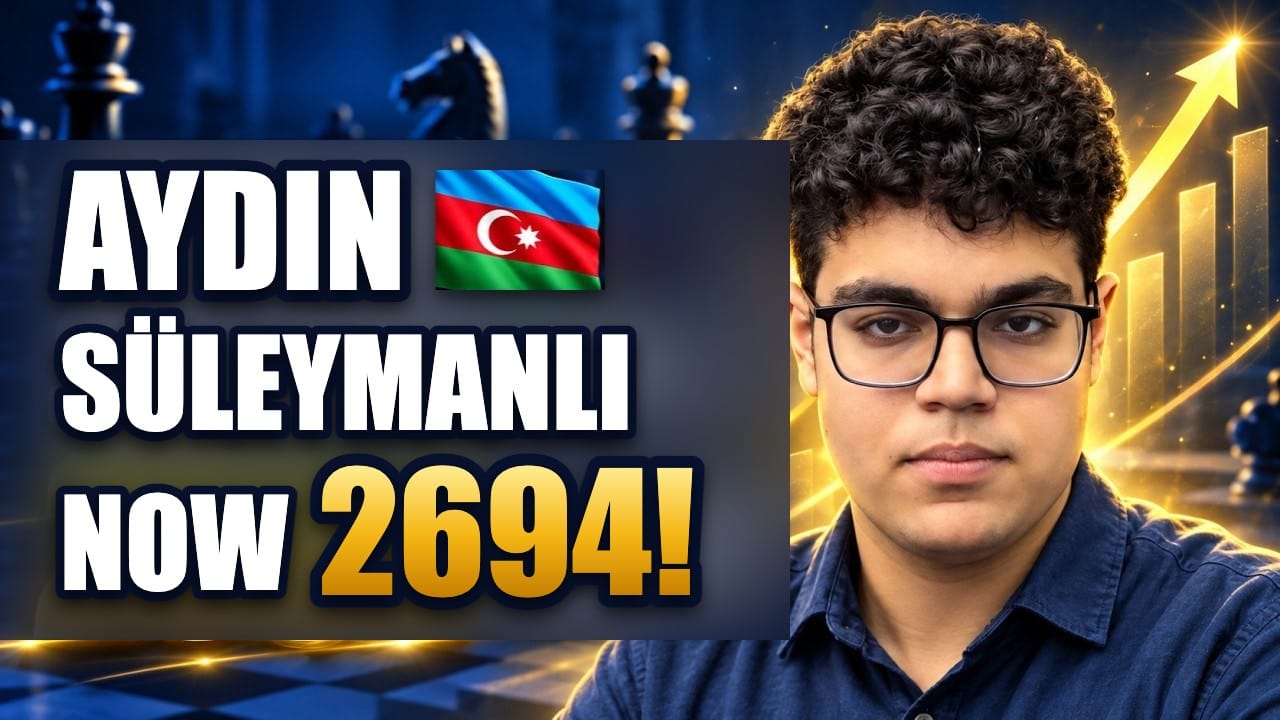
In round 10 of the Serbian Super League, Atilla Kuru defeated grandmaster Jingyao Tin (2602). Atilla, who has completed his final grandmaster norm and is waiting for FIDE to confirm the title, was playing at a 2576 performance and had gained 8 rating points in the event when the video was recorded.
In a game that grew out of the Scotch Game, White traded queens, left Black's bishop on a6 out of play and built up pressure in the endgame. As time trouble approached the position became very complicated; the variations even featured mating nets built with quiet moves in a queenless position. The move that ended the game is also the star of the video: 37.g6!!, a line-opening pawn sacrifice.
Below you can play through the whole game with a summary of the video commentary, and then solve the seven critical moments discussed in the video as puzzles.
Annotated Game
Click on the moves, use the buttons under the board or the arrow keys on your keyboard to step through the game. The green arrows and squares on the board show the ideas explained in the video.
Puzzles
The critical moments discussed in the video. Make your move on the board by dragging or clicking a piece. After a correct move your opponent's reply is played automatically; if the solution is longer, keep going. If you get stuck, Hint marks the piece you need to move. Some puzzles come from the variations shown in the video rather than from the game itself.
Puzzle 1 – move 10 (variation), Black to play
In the game White played 10.b3. But what if he had castled on autopilot with 10.O-O? Black to play and win the exchange.
Loading board…
10...Ba6! The bishop skewers the queen on e2 and the rook on f1 behind it. Interposing with 11.c4 does not help: the knight on b6 covers c4, so 11...Bxc4! follows, and once the queen moves the rook is lost. 9...Nb6 looked like a passive retreat, but it was preparing exactly this threat. Before every move, ask yourself: what will my opponent do when it is his turn?
Puzzle 2 – move 13 (variation), Black to play
Why didn't White play 12.c4? After 12.c4 Qb4+ 13.Nd2, Black to play and win a pawn.
Loading board…
13...Bxc4! 14.bxc4 Qxb2. When the b-pawn goes to c4 the b-file opens and the bishop on b2 is left hanging. That is why White played 12.Qe4 first in the game.
Puzzle 3 – move 28, White to play
With 27...Nd7 Black abandoned an important square. White to play.
Loading board…
28.Nd5! Once the knight left b6, nobody controls d5 any more, and the white knight jumps there at once. Black grabbed a pawn with 28...Rxb3, but after 29.Nxc7 the knight was inside the enemy camp. On move 27 Black needed ...f5 to keep control of this square; when you don't understand your opponent's idea, you miss the right move too.
Puzzle 4 – move 31, White to play
In the game 31.f5? was played and the advantage slipped away. Find the strong move suggested by the engine.
Loading board…
31.Rb8! pins the knight on b6 against the rook on b3. If Black tries to break free with 31...Rb2 and ...Nxc4, then 32.g4! Nxc4 33.Rxb2 Nxb2 34.f5 builds a mating net around the black king: 34...Nc4 35.Rc1 Ne5 36.Rc3 and there is no defence against Rh3 mate. In the game, after 31.f5? Rf3 the pawn fell.
Puzzle 5 – move 37 (variation), White to play and win
In the game 34...f5?? was played. Black's only good move was 34...Re5!: 35.Rg8 d5 36.Rh4+ Rh5. Now White has an incredible move.
Loading board…
37.Ng7!! The knight attacks the rook on h5 for the second time. If 37...Rxg7, then 38.Rxh5+ Kxh5 39.Rxg7 and White collects the pawns and wins. If 37...Rxh4, then 38.Nf5+ Kh5 and we reach the position of the next puzzle.
Puzzle 6 – move 39 (variation), White to play and mate in 4
After 37.Ng7!! Rxh4 38.Nf5+ Kh5. There are no queens on the board, but there is a mate!
Loading board…
39.h3!! A quiet move! The threat is g4 mate. If 39...Rxh3, then 40.g4#; if the rook goes to g4, hxg4 is mate. Black can only delay the mate by giving up material. Note: 39.Nxh4? Nxc4 40.Nf5 Ne5! and the knight stops g4 mate, while 41.h3 is met by ...Ng6.
Puzzle 7 – move 37, White to play and win
From the game: Black played 35...Rh4?? and 36.g5+ Kh5 followed. What is White's winning move?
Loading board…
37.g6!! A line-opening pawn sacrifice! If 37...hxg6, then 38.Rh8+ and mate follows. If 37...Rxf4, then 38.gxf7 and the pawn promotes. If 37...Kxg6, then 38.Rxh4 leaves White a whole rook up. In the game 37...Ra7 was played, and after 38.Rxh4+ Kxh4 39.g7 Rxg7+ 40.Nxg7 Black resigned on move 42.
Lessons from the Game
- Understand your opponent: 9...Nb6 looked like a retreat, but it prepared the threat ...Ba6. Never move without thinking about your opponent's reply: what will he do when it is his turn, and does my move give him an opportunity?
- A piece that has come out is not necessarily developed: The bishop on a6 was on the board but could not join the game. White traded queens and chose an endgame in which this bishop stayed bad.
- Bad bishop against strong knight: A knight on the blockade square in front of a pawn is worth far more than a bishop stuck behind its own pawns.
- One mistake leads to another: After 27.f4 Black missed ...f5; 27...Nd7 left d5 unguarded and 28.Nd5! followed.
- Mate without queens: Rooks, a knight and pawns wove mating nets around the black king. Quiet moves like 39.h3!! can be decisive even in queenless positions.
- The line-opening pawn sacrifice: 37.g6!! opened a line and ended the game at a stroke.
- Clock management: On move 21 Atilla had 1 hour 31 minutes left while his opponent had 33 minutes. Under time pressure in a complicated position, his opponent made mistakes.
Video Commentary
Source: game analysis originally published on Satranç Okulu Market (in Turkish).